Day 9: Beijing
Sunday, July 17, 2005
When the sun came over the horizon this morning, we were still in our berths in the sleeper car of our train. We had learned the night before, as we boarded the train, how heavily populated this country is, and how people must struggle for the smallest bit of space – including a berth on the train. This was a most unusual experience for all of us, but the train was cozy (although crowded) and it was a wonderful sensation to be rocked to sleep as the train moved across the countryside. As we awoke, we reminded each other sadly that this was to be our last full day in China.
Just as he had done on the very first night of our journey, Brother Liu met us at the station. Fully equipped with baggage carts and his permanent, infectious smile, he led us to the van that would take us to our hotel. What a relief: we had enough time to drop our bags, take a shower, and relax a bit before venturing out once again. The plan was to get cleaned up, have some lunch, and then go directly to Tiananmen Square and the Forbidden City.
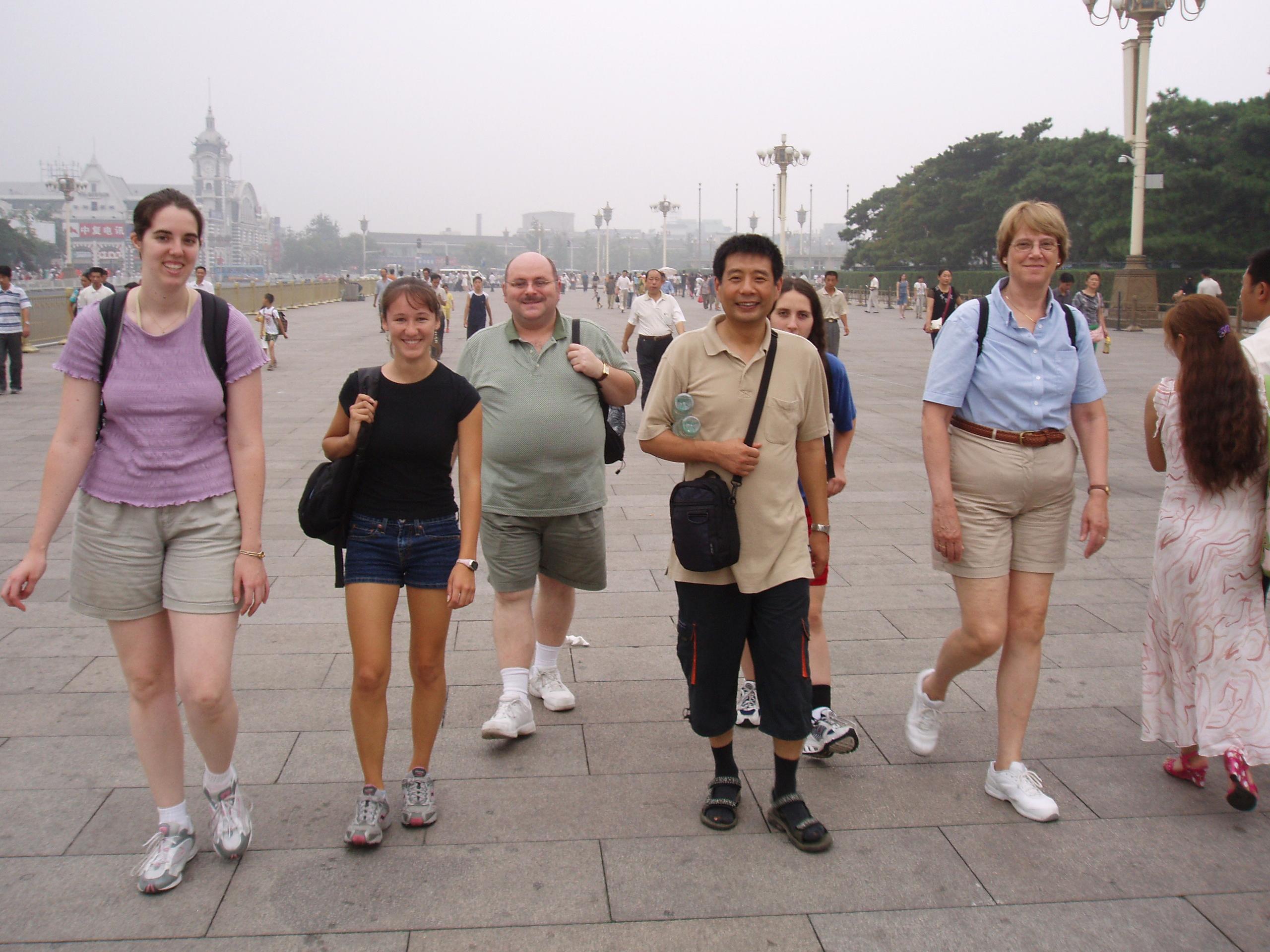
It’s a heady feeling to stand in the middle of Tiananmen Square that echoes with some of the most powerful events within the last four decades, not to mention the hundreds of precedent years. It has been the site of riotous exultation (the inception of the Cultural Revolution in ’66); of national mourning (the death of premier Zhou Enlai in ’76 which led to the massive riot known as the “Tiananmen Incident”); and social protest (the student “sit-in” in ’89 which ended in tragedy). We stood in awe and remembered these recent historical events – and marvel that they are only a small sampling of what has taken place here. Chairman Mao is interred here, and to this day people file past to pay their respects to the ex-chairman who lies on a slab of black granite from Taishan, one of the five sacred Taoist mountains. As you stand in the center of the square, which now serves as a park where couples stroll, children play, kite-flyers abound, and the less fortunate try to eke out a living begging or selling small souvenirs, it’s impossible to miss the huge portrait of Chairman Mao. That portrait in Tiananmen, which means “The Gate of Heavenly Peace” beckons you into The Forbidden City.
The Forbidden City was once the palace and home of the emperors of the Ming and Qing Dynasties, forbidden to the common man, and has been standing since 1421 (although much restoration has been done along the way). It is one of the finest examples of Chinese imperial architecture with its series of halls and buildings separated by passages, like a small city. According to legend, there are 9,999 rooms in this vast complex; we didn’t have the time or the energy left to find out if the legend is true. The beating sun and the crowds made for a hot and slow tour, and although we did our best to take in the beautiful marble carvings and staircases, we were happy when the bus arrived to fetch us.
Our next stop was the Temple of Heaven; a cosmological wonder. This whole complex serves as a channeling of prayer from the heavens to the earth where the Emperor at one time offered prayers for a bumper crop. To try and describe the architecture and proportions of this temple to anyone is almost impossible; this is one of those sites that you must visit and experience first hand. Brother Liu took us up on the Imperial Vault of Heaven; a huge structure constructed in nines. Nine steps separate each tier; nine huge slabs are laid on each tier; and on the top tier, nine stone rings. The number nine is especially significant in Chinese cosmology: there are nine layers of heaven. Brother Liu shows us that when you stand in the center mound on this temple if you clap or call out or speak aloud, the sound echoes and reverberates naturally and without help of a microphone. This is where the emperor spoke out his prayers for the harvest. It was very crowded with other visitors, so it was difficult to actually hear the echoing above the throng, but it was a magical and memorable experience. This temple offered us one of the funniest moments of the day as Daniel pointed out “The Animal Killin’ Pavilion” on the complex. Perhaps it was the heat, or fatigue, but he just sent us into bursts of hysterical laughter.
At the end of the day we were presented with a challenge, whether to eat famous Peking Duck (Beijing Duck) or experience Chinese Christian worship once more. I was so proud of our young pilgrims because they opted for worship (even though they were told how mouth-watering real Peking Duck is). We went to an evening worship at Brother Liu’s church. We sat in a pew high in the balcony, and each of us was given a monitor and headphones. From a remote sound booth Cathy translated for us, and we once again enjoyed the fellowship and warmth of our Christian brothers and sisters in China.
We ended our day with Pastor Joe administering communion which we shared with mixed emotions in our hearts, because tomorrow we must leave this beautiful country to return -- richly blessed and spirit-filled -- to our own beloved America.
Oh how much we have experienced, and how much we have to tell …
With great fondness,
Your loving band of pilgrims,
Megan Weymouth and
Dana Baker, Pam Koller, Peggy Matteson, Daniel McDuffie, Alicia Perras, and Joe Tripp